SciPy: The Engine for Scientific Computing in Python

While standard analytical libraries provide the foundation for manipulating data, the true mathematical heavy lifting in Python relies on SciPy. Standing for "Scientific Python," this powerhouse library is the bedrock of quantitative modeling, engineering, and advanced statistical analysis.
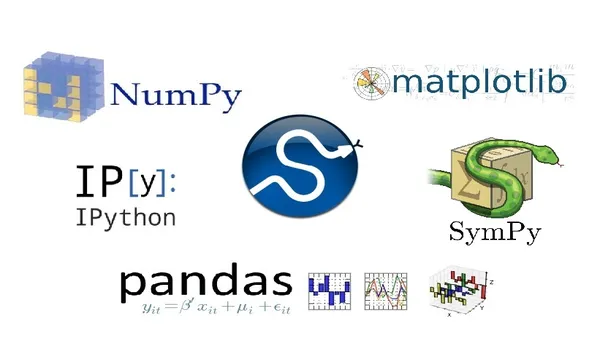
Key Takeaways for Analysts and Engineers
- Mathematical Depth: SciPy provides a comprehensive suite of algorithms for optimization, integration, interpolation, eigenvalue problems, and advanced statistics.
- The Foundation of AI: Many cutting-edge machine learning and data science frameworks rely heavily on SciPy's underlying mathematical routines.
- Built on NumPy: It perfectly extends the capabilities of NumPy, turning raw array operations into sophisticated scientific computations.
1. SciPy in the Data Analysis Ecosystem
In professional data engineering, simple arithmetic is rarely enough. Whether you are modeling complex risk scenarios, optimizing a financial portfolio, or analyzing signal processing data, you need robust mathematical solvers.
This is where SciPy excels. It offers specialized sub-modules (like scipy.optimize and scipy.stats) that handle these high-level mathematical problems efficiently. Instead of writing a complex curve-fitting algorithm from scratch, a quantitative analyst can deploy a highly optimized SciPy function in a single line of code.
2. Synergies with the Python Stack
SciPy does not operate in isolation; it is a critical component of a tightly integrated data ecosystem:
- The NumPy Connection: SciPy is fundamentally built on top of NumPy arrays. While NumPy handles the fast, efficient storage and manipulation of multi-dimensional data, SciPy provides the advanced mathematical tools to analyze that data.
- Accelerated Workflows: When paired with libraries like Numba for JIT compilation, SciPy routines can be integrated into custom, ultra-fast computational pipelines that rival the speed of C++ or Fortran.
- Data Visualization: The outputs generated by SciPy's complex models—such as probability distributions or interpolated surfaces—are frequently passed directly into visualization libraries to create interactive, dynamic dashboards.
Conclusion
SciPy bridges the gap between basic data manipulation and profound scientific inquiry. By offering a vast library of pre-compiled, rigorously tested mathematical functions, it empowers data scientists to focus on solving real-world problems rather than reinventing the mathematical wheel.
For anyone serious about pushing the boundaries of quantitative analysis in Python, mastering SciPy is an absolute imperative.
Note: This article is part of our Science and Technologies series, focusing on the quantitative foundations of modern analysis.