Using Gamma Exposure (GEX) to Time Your Option Trading

The difference between a winning trade and a losing trade is rarely just direction; it is almost always timing. In the quantitative finance space, traditional timing indicators like RSI or MACD are considered lagging and often unreliable.
Instead, modern strategic analysts look at the mechanical structure of the market to time their entries and exits. The most powerful tool for this structural timing is Gamma Exposure (GEX).
Moving from "What" to "When"
While fundamental analysis might tell you what asset to buy, it is terrible at telling you when to buy it. Gamma Exposure bridges this gap by revealing the immediate liquidity needs of the market makers.
When you know where the market makers have to buy or sell, you can predict the "path of least resistance" for the underlying asset.
Timing the Breakout (The Negative GEX Strategy)
One of the most difficult things in trading is identifying whether a breakout is genuine or a "fake-out." GEX provides a clear mathematical answer.
The Setup
Assume a stock is approaching a major resistance level. If the overall Gamma Exposure of the market is heavily positive, market makers will be selling into that resistance to hedge their books.
- The Timing Signal: Do not buy the breakout. The positive GEX will likely act as a heavy blanket, suppressing the move and causing the price to mean-revert.
However, if the overall Gamma Exposure flips to negative as the price approaches resistance:
- The Timing Signal: This is the time to strike. In a negative GEX environment, market makers are forced to buy the underlying asset as the price rises. This mechanical buying will fuel the breakout, causing violent, sustained momentum.
Timing the Mean Reversion (The Zero-Line Bounce)
The "Zero-Gamma" level is the absolute epicenter of market timing. This is the exact price point where the total Gamma exposure of the market is zero.
The Strategy
When the market is in a positive GEX regime and experiences a sudden pullback, the Zero-Gamma line often acts as an impenetrable floor.
- The Timing Signal: As the price drops and approaches the Zero-Gamma line, market makers are forced to buy the underlying asset to hedge. This creates massive structural support. An academic trader will time their entry (selling put credit spreads or buying calls) exactly at this Zero-Gamma line, anticipating the mechanical "bounce" back upward.
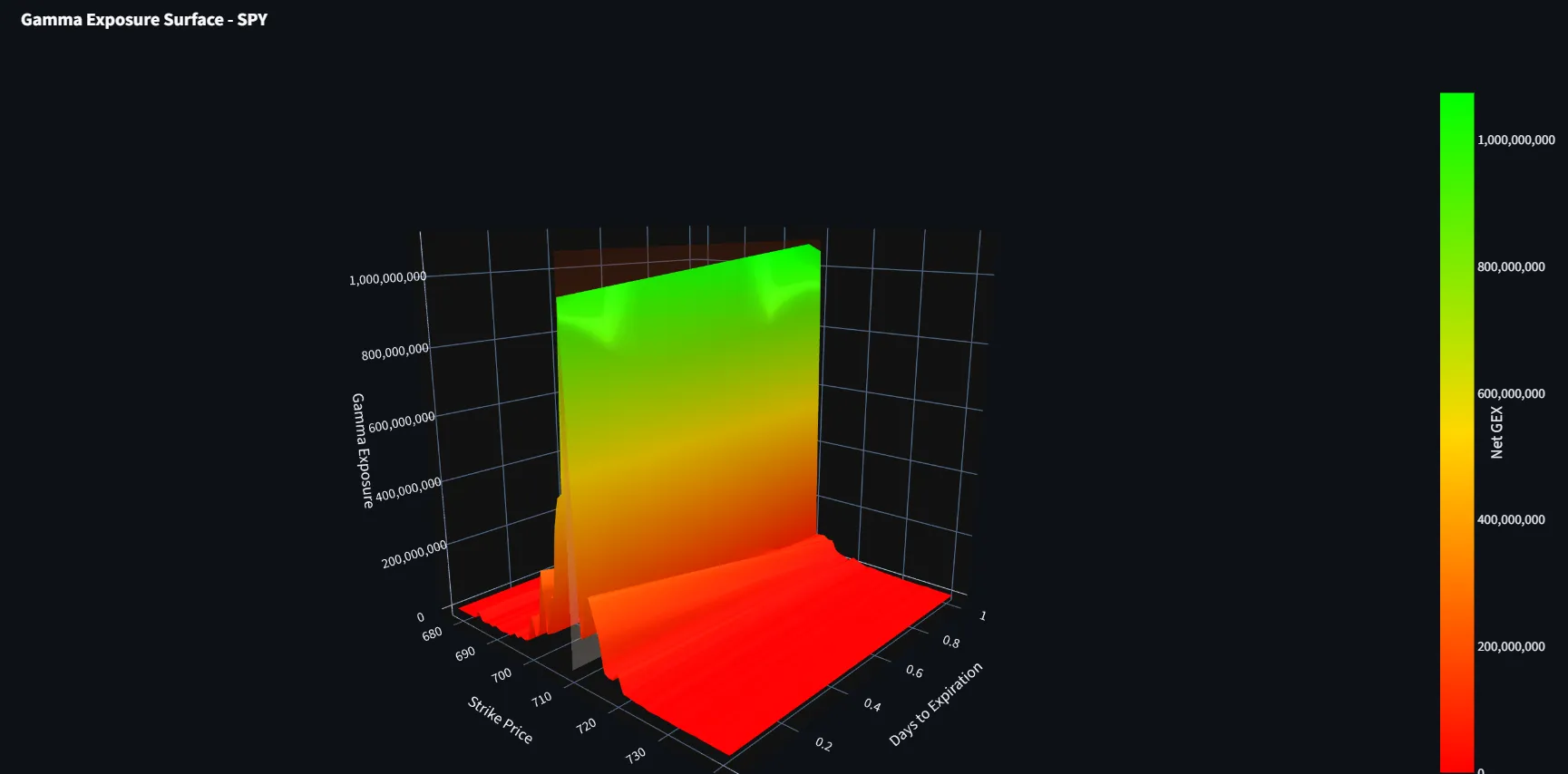 The 3D Gamma Surface allows you to visualize these peaks and valleys, mapping out exact timing zones for your entries.
Identifying Exhaustion Points
Every rally and every sell-off eventually runs out of fuel. GEX helps you time these exhaustion points perfectly.
If a stock has been rallying for days, look at the distribution of call Gamma. Eventually, the price will reach a strike where the call Gamma drops off a cliff (a "Gamma Vacuum").
- The Timing Signal: When the price reaches this vacuum, the market makers are no longer forced to buy the asset. The mechanical fuel is gone. This is the precise moment to take profits on your long positions or initiate contrarian, mean-reverting trades.
Conclusion
Timing the market is impossible if you are relying on guesswork or lagging technical lines. However, when you use Gamma Exposure, you are no longer guessing. You are simply reading the order book of the market makers.
By using tools like the 3D Gamma Surface provided by Dashboard Options, you can align your trade timing with the inescapable, mathematical reality of institutional hedging.