How Option Dealers Use Gamma Exposure (And How You Can Too)

When we analyze modern financial markets, it is easy to get lost in macroeconomic narratives and fundamental valuations. However, the true "plumbing" of the market—the mechanical flows that force prices up or down regardless of news—is controlled by option dealers.
Understanding how these dealers use Gamma Exposure (GEX) to manage their books is the key to anticipating market turning points before they happen.
The Mechanical Mandate of Dealers
Unlike retail traders who buy options to speculate on direction, option dealers (market makers) are in the business of collecting the spread and charging the premium. Their primary mandate is to remain Delta Neutral.
If a dealer sells you a call option, they are instantly "short Delta" (they lose money if the underlying asset goes up). To neutralize this risk, they must buy shares of the underlying asset. But Delta is not static; it changes as the price of the asset moves. This rate of change is called Gamma.
The Hedging Feedback Loop
Because Delta changes, dealers cannot just hedge once and walk away. They must dynamically adjust their hedges as the market moves. The sum total of their required adjustments across all strikes is their Gamma Exposure (GEX).
- In Positive GEX Environments: Dealers sell into rallies and buy into dips. This dynamic hedging absorbs volatility, causing the market to grind slowly or trade sideways.
- In Negative GEX Environments: Dealers are forced to buy into rallies (adding fuel to the fire) and sell into dips (exacerbating crashes). This creates explosive, directional momentum.
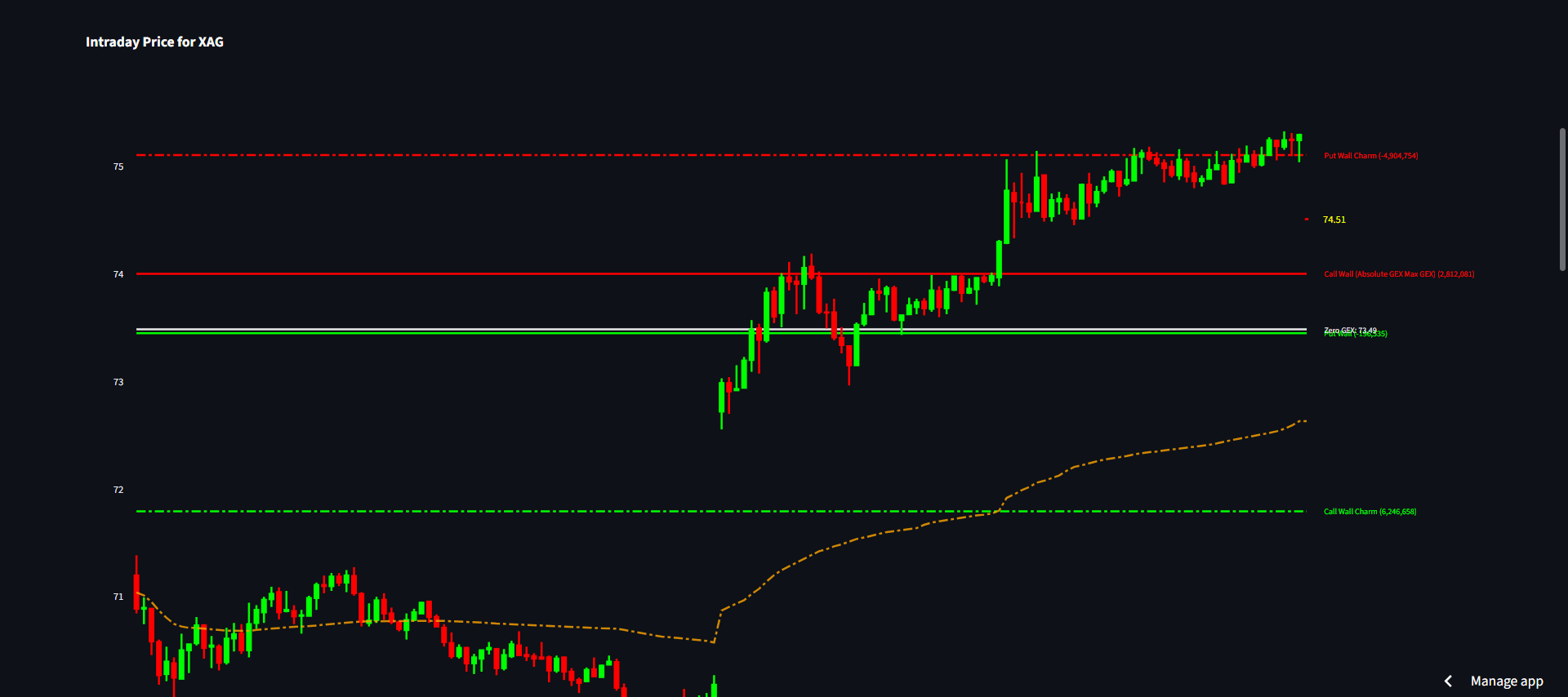 Visualizing dealer Gamma distributions provides a clear roadmap of where hedging flows will dictate price action.
How You Can Use Gamma Exposure
You do not need to be a billion-dollar market maker to use GEX. By analyzing dealer positioning through platforms like Dashboard Options, you can align your strategies with the "smart money" flows.
1. Identifying the "Gamma Flip" (The Zero-Line)
The most actionable piece of data on any GEX chart is the point where dealer exposure crosses from positive to negative.
- Strategy: If the market price crosses below the zero-line, expect volatility to spike. This is the time to tighten stop-losses, avoid selling credit spreads, and look for momentum breakdown plays. If the price is above the zero-line, mean-reversion strategies (like Iron Condors) become statistically favorable.
2. Trading the "Gamma Magnets"
High concentrations of GEX act as gravitational centers for price. Dealers have massive hedging requirements at these specific strikes, which often causes the price to "pin" there near expiration.
- Strategy: If you see a massive Gamma wall at 5000 on the S&P 500, and the current price is 4980 with three days to expiration, the path of least resistance is toward 5000. You can construct defined-risk trades (like butterflies or calendar spreads) centered exactly on that magnet strike.
3. Avoiding the "Vacuum Zones"
Conversely, areas with very little Gamma exposure are "vacuum zones." If the price enters these zones, there is no dealer liquidity to slow the momentum down, leading to rapid, unpredictable price discovery.
- Strategy: Avoid selling premium in these zones, as the risk of a violent expansion in implied volatility is exceptionally high.
Conclusion
Option dealers do not control the market maliciously; their actions are purely mechanical, dictated by the strict mathematical rules of Greek hedging. By studying Gamma Exposure, you are effectively reading the dealer's playbook.
When you trade in alignment with dealer flows, you are no longer swimming against the tide—you are riding the massive wave of institutional liquidity.