How Gamma Exposure Works - Advanced Option Strategies

In the complex ecosystem of modern financial markets, price action is rarely driven by fundamental news alone. Instead, the hidden mechanics of the options market—specifically Gamma Exposure (GEX)—often dictate the speed, direction, and magnitude of market movements.
Understanding how Gamma Exposure works is no longer an optional skill; it is a fundamental requirement for any serious quantitative analyst or trader.
The Core Concept of Gamma Exposure (GEX)
To understand Gamma Exposure, we must first understand the role of the Market Maker (MM). Market makers provide liquidity by taking the opposite side of retail and institutional options trades. However, they do not want to take on directional risk. To remain market-neutral, they must constantly buy or sell the underlying asset (like the S&P 500) to hedge their positions.
This dynamic hedging process is governed by Gamma, which measures the rate of change of an option's Delta. Gamma Exposure (GEX) is the aggregate amount of Gamma that market makers hold across all strike prices and expirations.
Positive vs. Negative Gamma Regimes
The absolute value of GEX is important, but its sign (positive or negative) dictates the "regime" or state of the market.
1. The Positive Gamma Regime (The Stabilizer)
When market makers hold a net positive Gamma position (usually when investors are heavily buying Calls or selling Puts), the market enters a stabilizing regime.
- The Mechanics: As the price of the underlying asset rises, MMs must sell the asset to stay delta-neutral. As the price falls, they must buy the asset.
- The Result: This constant "buying the dip and selling the rip" suppresses volatility. The market tends to move slowly, trading in tight, predictable ranges.
2. The Negative Gamma Regime (The Accelerator)
When market makers are in a net negative Gamma position (typically when the market is crashing and investors are aggressively buying Puts for protection), the mechanics flip entirely.
- The Mechanics: As the underlying price falls, MMs are forced to sell the asset to hedge their short put positions. As the price rises, they are forced to buy.
- The Result: Market makers are now trading with the momentum rather than against it. This creates violent, accelerated price swings, leading to massive gap-downs or explosive short-covering rallies.
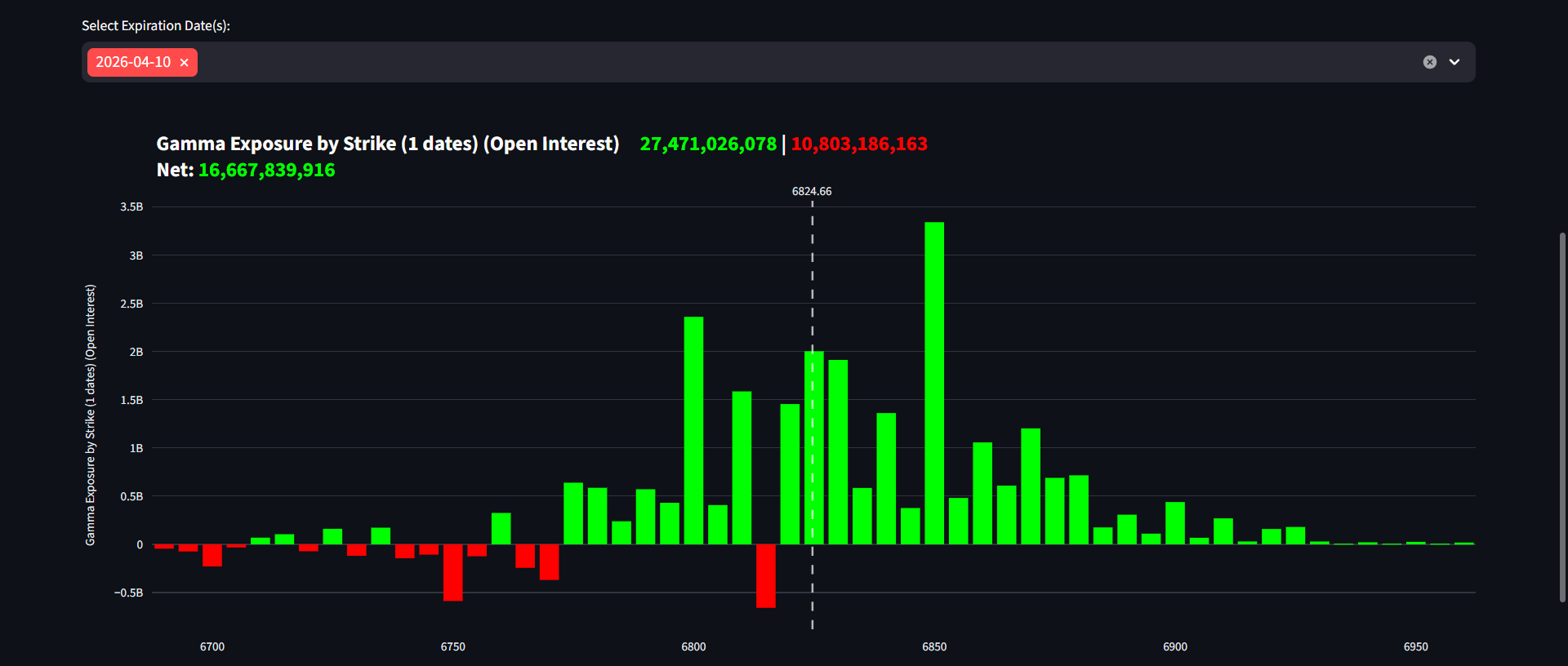 Visualizing the Gamma topography to identify critical levels where hedging flows will heavily influence price action.
Advanced Strategic Implementation
How can quantitative traders use this academic understanding of GEX to generate alpha?
Identifying Gamma Walls
A "Gamma Wall" is the specific strike price with the largest concentration of Gamma Exposure. In a positive Gamma environment, this wall acts as an impenetrable ceiling. Price action will naturally gravitate toward this level but struggle to break through it, making it an ideal target for Iron Condors or covered calls.
The Gamma Flip Zero-Line
The most critical level on any GEX chart is the "Zero-Gamma" level (the price where GEX flips from positive to negative). When an asset crosses this threshold, the entire market regime changes instantly. Quantitative models use this level as an "on/off switch" for volatility strategies. If the price falls below the zero-line, statistical models immediately adjust to price in higher standard deviations.
Conclusion
Gamma Exposure is the gravitational force of the modern options market. By utilizing platforms like Dashboard Options, traders can map out these unseen forces, transitioning from reacting to price action to predicting the institutional flows that cause it.
Mastering GEX is not just about understanding an option Greek; it is about understanding the structural physics of the market itself.