How To Trade Gamma Exposure (GEX): A Complete Quantitative Guide

For decades, retail traders have relied on fundamental analysis or basic chart patterns to navigate the stock market. However, the modern financial market is no longer driven purely by human sentiment; it is driven by algorithmic hedging and options dealers.
At the center of this mechanical market structure is Gamma Exposure (GEX). If you do not understand how to trade GEX, you are effectively trading blind. This guide will serve as your complete academic framework for trading Gamma Exposure.
The Core Philosophy of Trading GEX
Trading Gamma Exposure requires a fundamental shift in mindset. You must stop asking, "What do I think the stock will do?" and start asking, "What are the market makers mathematically forced to do?"
Market makers (Option Dealers) must remain Delta Neutral. To do this, they constantly hedge their books. GEX is simply the measure of how aggressively they must hedge. When you trade GEX, your goal is to align your trades with these inescapable, institutional hedging flows.
Step 1: Identify the Market Regime
Before placing a single trade, you must identify whether the market is in a Positive or Negative Gamma regime.
The Positive Gamma Regime (The Slow Grind)
If total market GEX is heavily positive, dealers will sell into rallies and buy into dips.
- The Strategy: This is a mean-reverting environment. Breakouts will fail. You should focus on Theta-collection strategies.
- Actionable Trades: Iron Condors, Short Strangles, Call/Put Credit Spreads. Let the market makers suppress the volatility while you collect the time decay.
The Negative Gamma Regime (The Volatility Expansion)
If total market GEX falls below zero, dealers will sell into dips and buy into rallies, exacerbating the momentum.
- The Strategy: This is a trend-following, high-volatility environment. Mean-reversion will destroy your account here. You must become Long Vega.
- Actionable Trades: Long Puts, Long Calls (during short-covering rallies), Debit Spreads. Trade with the momentum and expect massive intraday swings.
Step 2: Locate the Gamma Walls
Once you know the regime, you need to find your targets. Gamma Walls are specific strike prices with massive concentrations of GEX.
- In a Positive Regime: These walls act as heavy resistance or strong support. If the S&P 500 approaches a massive 5200 Call Gamma Wall, the dealer selling pressure will make it exceptionally difficult to break. You can structure your short credit spreads exactly at these walls.
- In a Negative Regime: These walls act as gravitational magnets. If support breaks, the price will "waterfall" directly down to the largest Put Gamma Wall. You can use these walls as your exact profit targets for your long Put positions.
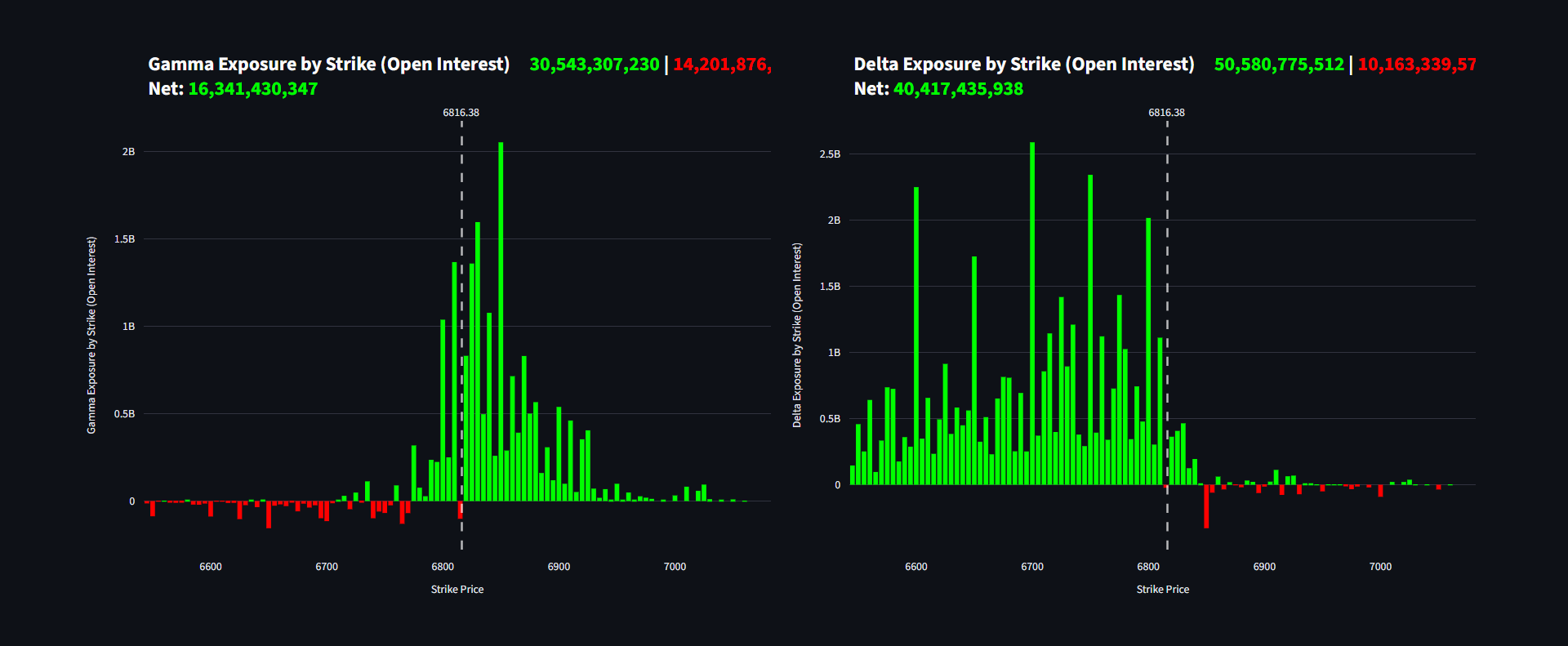 Using tools like Dashboard Options to map out GEX and DEX (Delta Exposure) provides a clear, quantitative roadmap of dealer positioning.
Step 3: Trade the Zero-Gamma Pivot
The Zero-Gamma line is the exact boundary between the positive and negative regimes. It is the most critical pivot point in quantitative finance.
- The Bounce: If the market drops rapidly toward the Zero-Gamma line from above, anticipate a mechanical bounce. Dealers will buy aggressively to support this level.
- The Break: If the market slices cleanly through the Zero-Gamma line, do not try to catch the falling knife. The hedging mechanics have flipped to negative, and volatility is about to explode.
Conclusion
Trading Gamma Exposure elevates your methodology from retail speculation to institutional probability. By utilizing the advanced analytics available on Dashboard Options, you can map out the dealer landscape and structure your trades with a true mathematical edge.
Stop fighting the hidden flows of the market, and start trading alongside them.