How to Trade Positive Gamma: Strategies for Calm Markets

Many novice traders approach the market with a "one-size-fits-all" strategy, buying breakouts or selling premium regardless of the underlying structural environment. As an academic strategic analyst, I can tell you that this is a mathematical error.
The environment dictates the strategy. When the market is in a Positive Gamma regime, the rules of price action change completely. If you do not adapt, the market will slowly bleed your capital dry.
The Physics of Positive Gamma
To trade Positive Gamma, you must understand the mechanical forces at play. In a Positive Gamma environment, the aggregate positioning of option dealers (market makers) is net long Gamma.
This means that as the market price rises, the dealers' Delta increases, forcing them to sell the underlying asset to remain neutral. Conversely, as the market falls, their Delta decreases, forcing them to buy the underlying asset.
- The Result: Every rally is met with institutional selling, and every dip is met with institutional buying.
- The Market Behavior: Volatility is suppressed. The market experiences tight daily trading ranges, slow upward grinds, and immediate mean-reversion after minor shocks.
Strategic Adaptation: What NOT to Do
In a Positive Gamma environment, certain strategies become statistically unfavorable:
- Do Not Buy Breakouts: Because market makers are selling into rallies, breakouts are highly likely to fail and revert to the mean.
- Avoid Long Straddles/Strangles: Buying volatility is a losing game. The market makers are actively crushing volatility, meaning Theta (time decay) will destroy long premium positions before they can become profitable.
Strategy 1: Short Premium (Theta Collection)
The most robust way to trade a Positive Gamma regime is to align yourself with the market makers and become a premium seller.
- The Strategy: Iron Condors, Short Strangles (for advanced traders), and Credit Spreads.
- The Logic: Because price action is pinned into tight ranges, the probability of the underlying asset staying between your short strikes is exceptionally high. You allow the natural, suppressed volatility to work in your favor, collecting Theta decay every day.
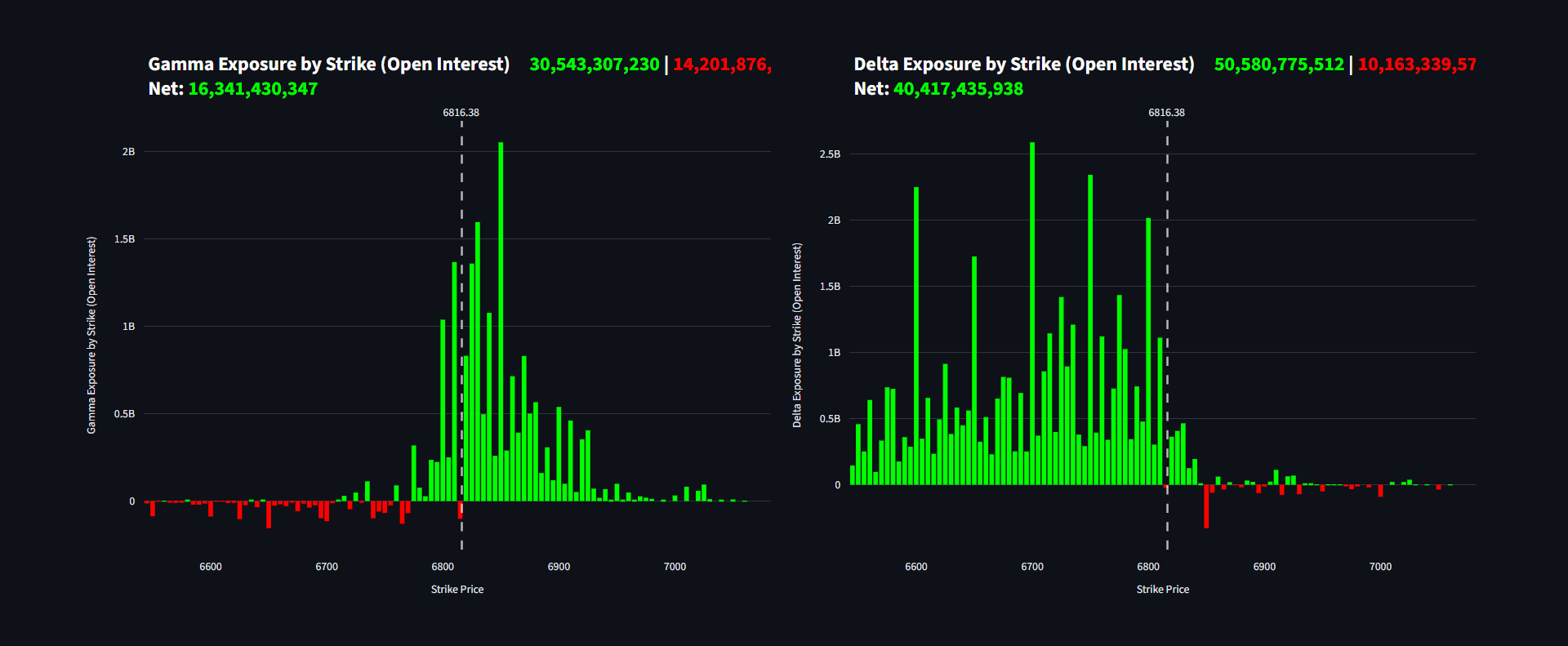 Analyzing the relationship between Gamma and Delta helps identify the exact strikes where market makers will aggressively hedge, creating "walls" that trap the price.
Strategy 2: Trading the "Gamma Walls"
In a Positive Gamma environment, large concentrations of Gamma act as impenetrable walls. Using quantitative tools like Dashboard Options, you can visualize exactly where these walls are located (e.g., a massive Call Gamma concentration at the SPX 5100 strike).
- The Strategy: If the price approaches this Gamma Wall, you can initiate mean-reverting trades (like selling Call Credit Spreads right at the wall). The dealer hedging flows will actively defend this strike, providing you with a high-probability structural advantage.
Strategy 3: The "Buy the Dip" Algorithm
Because market makers are mechanically forced to buy the underlying asset when the price drops, pullbacks in a Positive Gamma regime are almost always shallow and short-lived.
- The Strategy: Instead of buying puts when the market dips, academic traders will sell Cash-Secured Puts or execute Bull Put Spreads. This capitalizes on the elevated (and often overpriced) implied volatility during the dip, knowing that the structural buying pressure will soon push the price back up.
Conclusion
Trading Positive Gamma is an exercise in patience and statistical discipline. It is not the environment for "home run" trades or massive directional bets. Instead, it is the environment for steady, consistent income generation through Theta decay and mean-reversion.
By reading the Gamma landscape, you can stop fighting the market makers and start trading alongside them.